


Medium
OAuth consumers retain access after token expiry
CVE-2026-57218 · CWE-863
RabbitMQ
Reproduced
Verified
Apex investigates like an attacker, tracing subtle logic flaws and chained exploits through code and running systems that scanners and even expert reviews have already cleared.
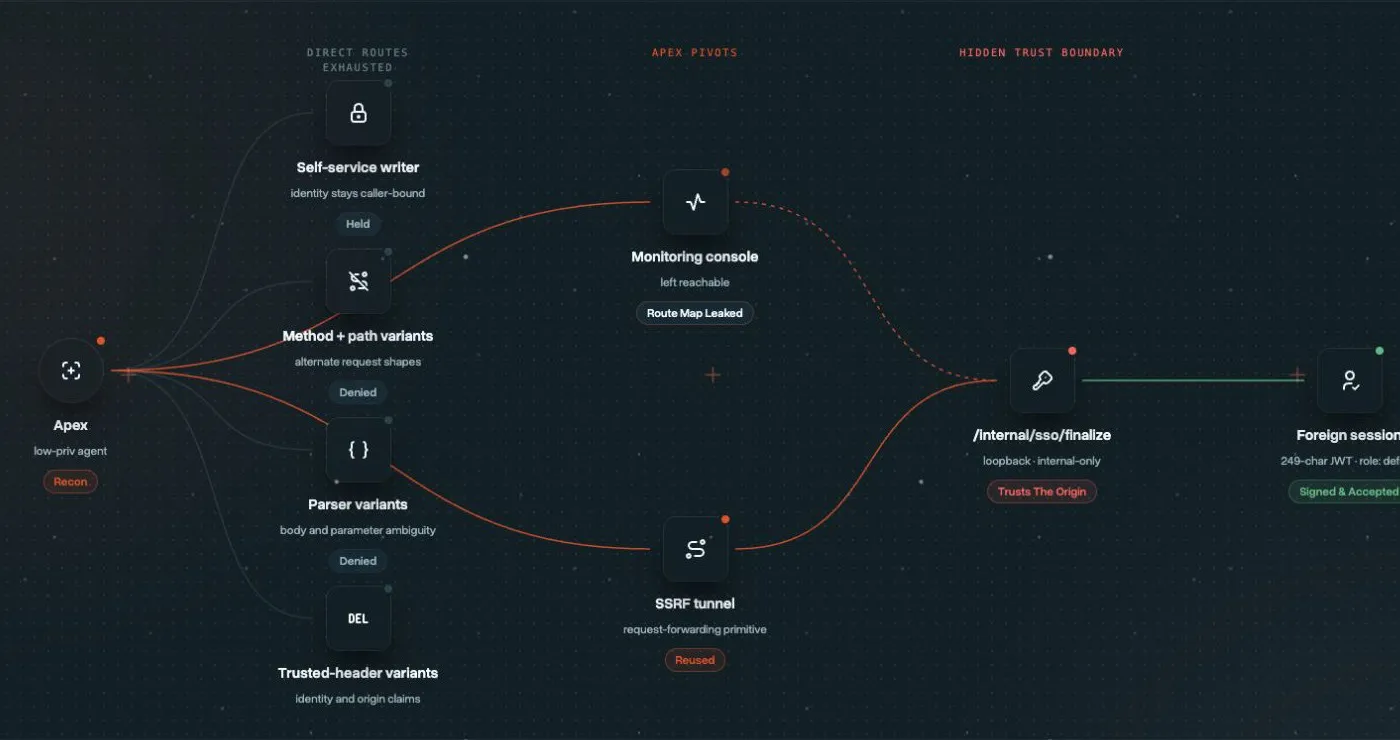
Most tools stop at the first clean denial. Apex exhausted the obvious doors, ran a 59-variant bypass sweep, then changed direction until it found the hidden route that gave way.
Recorded attack path
The full recorded path is shown below
Exploit evidence / remediation status
#1 on the HackerOne leaderboard
Medium
CVE-2026-57218 · CWE-863
RabbitMQ
Reproduced
Verified
High
CVE-2026-57217 · CWE-755
RabbitMQ
Reproduced
Verified
Medium
CVE-2026-57216 · CWE-290
RabbitMQ
Reproduced
Verified
24 public disclosures across 15 projects
Closed loop
Apex follows the attack path across files, services, identities, and runtime behavior to expose the subtle, chained vulnerabilities that pattern matching misses. Then it writes the fix and verifies it.
Six representative examples.
Traditional
A scanner flags a pattern that might be vulnerable.
Apex
Apex traces a real attack path through the codebase.
Traditional
Your team investigates every finding without production context.
Apex
Apex determines what is reachable, relevant, and exploitable.
Traditional
Security asks engineering to reproduce and prove the issue.
Apex
Apex builds the proof of concept and validates the impact.
Traditional
Another ticket enters an already crowded backlog.
Apex
Apex writes the fix and opens a pull request.
Traditional
Engineering has to interpret guidance and ship the remediation.
Apex
Apex delivers a tested patch that is ready to review.
Traditional
A re-scan starts the same cycle all over again.
Apex
Apex verifies the remediation and closes the loop.
Whether Apex starts with a repository, a pull request, a running application, or an existing finding, it follows the same path: investigate in context, prove what's exploitable, generate the fix, and verify the result.
Start with a repository, pull request, running application, or an existing finding from Apex or another tool.
Apex analyzes the relevant code and connected systems to understand how an attacker could reach the issue.
It validates reachability, attacker-controlled input, and real impact, or explains why the issue isn't exploitable.
Based on your policy, Apex generates the remediation, opens the pull request, or routes for human review.
Apex retests the change and records evidence that the issue has been resolved.
Apex brings code, dependencies, cloud, APIs, secrets, running applications, and AI systems into one place. Instead of stitching together disconnected scanner output, your team works from a single system that surfaces verified vulnerabilities and drives them to resolution.
Trace attacker reachability and real impact instead of escalating every theoretical issue.
Generate the remediation, open a pull request where configured, and verify the fix.
Apply the same reasoning and policies across code, dependencies, cloud, APIs, AI systems, and runtime.
Choose your autonomy level, require approval for consequential actions, and keep every decision logged and attributable.
The security surface Apex understands, across your code and the systems around it.
Security review that catches logic flaws, auth bypasses, and injection paths that scanners miss, fast enough to keep up with AI-accelerated development.
Apex identifies the vulnerable symbol from an advisory and traces the call graph to prove whether it's actually reachable, turning a wall of CVE noise into the handful that matter, then opening the version-bump PR.
Apex finds leaked secrets, tests (read-only) whether they're still live, scopes how far back in git history they reach, then drives revoke, rotate, and purge, and adds pre-commit / CI scanning so it can't recur.
Misconfiguration is the most common AppSec failure mode. Apex surfaces public buckets, over-permissive IAM, and cloud exposure, graded by real data sensitivity and actual usage, before it becomes an incident.
Finds vulnerabilities across the model interfaces, APIs, and agent surfaces you're shipping, covering the new attack surface most tooling ignores.
Apex meets your code at every stage, from a first look to an outside-in attack. Match the mode to the moment.
A full, context-aware pass over a repository, reasoning across your whole codebase about architecture, trust boundaries, and attacker paths.
A deeper, higher-budget pass with broader hunting and stricter validation for high-risk, trust-boundary-heavy codebases.
Catches vulnerabilities in changed code before it merges, reviews the diff in CI and posts checks and comments on the pull request.
Ship a fix and let Apex confirm it, retests the original finding against your patch and flags anything the fix may have introduced.
A fast, low-cost pass between deeper reviews, so nothing goes unchecked while you wait on a full audit.
Attacker's-eye testing of your running web app, real browser and session state to find ATO, IDOR, privilege escalation, and exposed data.
Expert-led offensive engagements across web, mobile, APIs, and AI systems, backed by proof and a report you can hand to auditors.
Run Apex from your terminal, CI pipeline, or coding agent, kick off scans, pull findings, and export results without leaving your workflow.
I was truly impressed by the subtle bugs that Cantina uncovered in an open-source cryptographic repository that I maintain, which had already gone through thorough reviews. Their AI-powered tool acts as a valuable safety net to catch bugs that humans and other tools may have missed.

Security leaders keep asking for the same thing: a platform that helps security operate as a real partner to engineering, not just a team that sends vulnerability tickets. That's the job Apex was built to do.
See how Apex investigates across your attack surface, proves what’s exploitable, and carries real issues through remediation and verification.