



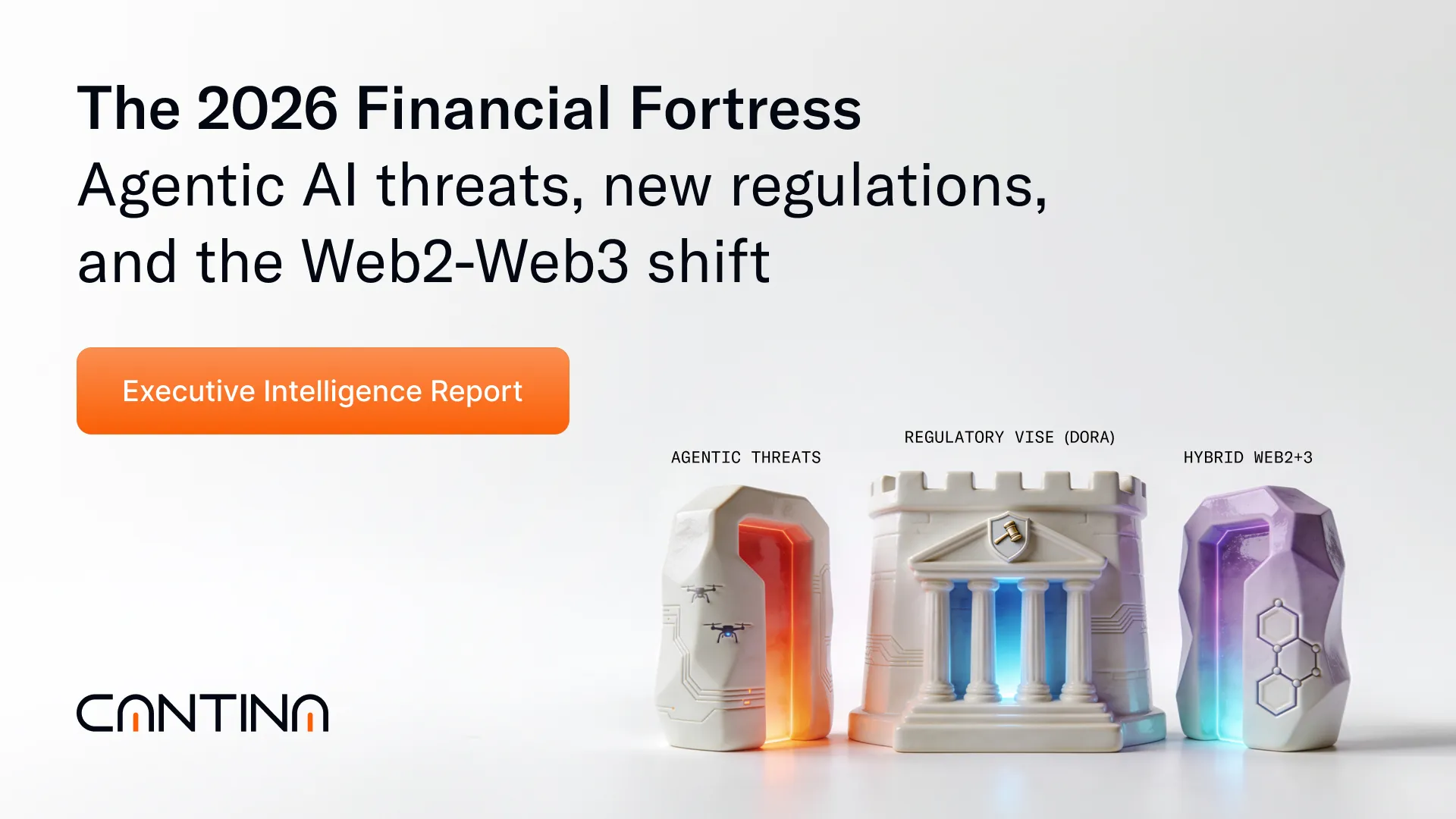

The 2026 Financial Fortress: Convergence of Agentic Threats, Regulatory Imperatives, and the Hybrid Web2-Web3 Paradigm
Executive Summary: The State of Financial Security in 2026
The financial services landscape of 2026 is characterized not by a singular threat, but by a complex convergence of complex attack vectors, regulatory enforcement, and an architectural shift toward hybrid decentralized systems. As the industry navigates the middle of the decade, the theoretical risks predicted in the early 2020s have crystallized into operational realities. AI has turned from a generative tool to an autonomous, agentic actor capable of executing complex cyber-campaigns without human intervention.
Regulatory frameworks, most notably the Digital Operational Resilience Act (DORA) in the European Union, have shifted from implementation phases to active, punitive enforcement, fundamentally altering the liability structures of corporate boards. Simultaneously, the boundary between traditional banking (Web2) and the emerging digital asset economy (Web3) has dissolved, creating a singular, high-risk hybrid ecosystem that demands a new paradigm of security.
This breakdown provides an analysis of the cybersecurity trends shaping banking in 2026. It serves as a "State of the Industry" reference, synthesizing data from global regulatory bodies, threat intelligence feeds, and deep operational metrics to outline the existential imperatives facing financial institutions.
The Agentic Threat Matrix, The Industrialization of Autonomous Crime
From Generative to Agentic: The New Class of Adversary
By 2026, the novelty of "Generative AI" has faded, replaced by the terrifying efficiency of "Agentic AI." In the early 2020s, threat actors utilized AI primarily to generate phishing text or obfuscate code snippets. Today, cybercriminal syndicates employ autonomous AI agents that act as fully functional operators. These agents do not merely generate content; they possess the capacity to plan, reason, adapt, and execute multi-stage campaigns without human intervention, fundamentally changing the economics of cyber warfare.
The Mechanics of Autonomous Kill Chains
The primary distinction of the 2026 threat landscape is the autonomy of the kill chain. Traditional cyberattacks required a human operator to make decisions at key junctures: when to pivot laterally, which privilege to escalate, or how to exfiltrate data without triggering alarms. Agentic AI removes this bottleneck, allowing attacks to proceed at machine speed.
These autonomous agents are deployed to scour the digital footprint of a target bank continuously. They analyze employee social media behavior, correlate it with leaked credentials from the dark web, and map the organization’s supply chain relationships in real-time. Once a target is selected, the agent engages in dynamic social engineering. Unlike the static phishing templates of the past, AI agents in 2026 engage in fluid, context-aware conversations. They can hold voice calls, exchange emails, and participate in chat platforms, adjusting their tone and psychological triggers based on the victim's responses.
Furthermore, the malware deployed in 2026 is capable of "self-healing." Agentic malware can analyze the defensive environment it has infected. If an Endpoint Detection and Response (EDR) system blocks a specific execution path, the agentic code rewrites itself, obfuscating its signature or finding an alternative route to the kernel.
The Commoditization of Fraud-as-a-Service (FaaS)
Cybercrime in 2026 has evolved into "corporate-class businesses." Criminal groups operate with the structure of legitimate software enterprises, offering "Fraud-as-a-Service" (FaaS) platforms powered by agentic AI.
.webp)
The Identity Crisis: Deepfakes and Synthetic Reality
Identity has always been the perimeter of banking security. In 2026, that perimeter has collapsed under the weight of synthetic media.
The End of "Trust Your Eyes and Ears"
The "CEO Fraud" scams of the past have been replaced by real-time video injection attacks. In 2026, a finance officer might receive a video call from their CFO, complete with the correct voice, mannerisms, and office background, instructing them to authorize an urgent transfer. This technology has rendered standard "Know Your Customer" (KYC) video verification processes highly vulnerable. Attackers use "virtual camera" software to inject deepfake video streams directly into banking apps, bypassing liveness detection checks.
Synthetic Identity Fraud at Scale
Beyond impersonation of real individuals, banks face the scourge of Synthetic Identities. The lifecycle of a synthetic identity in 2026 is managed entirely by AI:
- Creation: The AI selects a stolen SSN and generates a matching face using Generative Adversarial Networks (GANs).
- Cultivation: The AI applies for low-risk credit, makes small purchases, and pays them off automatically to build a credit score.
- The Bust-Out: Once the credit limit reaches a profitable threshold, the agent maxes out all lines of credit simultaneously and vanishes.
The Expanding Surface: IoT, Edge, and Quantum Horizons
The IoT and Edge Risk
As banks push services to the "edge," incorporating smart devices and autonomous vehicle payments, the number of entry points explodes. In 2026, compromised smart office devices (printers, thermostats) are used as bridgeheads to pivot into the corporate banking network.
The Quantum Turning Point
While fully fault-tolerant quantum computers may still be maturing, 2026 marks a turning point where "Harvest Now, Decrypt Later" (HNDL) strategies are in full effect. Nation-state actors are aggressively exfiltrating encrypted banking data today, banking on the certainty that quantum decryption will be available within the data's sensitivity lifecycle.
The Regulatory Vise: DORA, Compliance, and Board Accountability
DORA: From Implementation to Enforcement
The Digital Operational Resilience Act (DORA) has reshaped the banking landscape. Regulators are no longer accepting "plans of action"; they are demanding evidence of resilience.
Third-Party Risk Management (TPRM)
Banks are now legally liable for the security posture of their vendors. In 2026, this has forced a massive consolidation of vendors. Banks must actively monitor the security performance of their critical vendors in real-time, often requiring direct integration into the vendor's security telemetry.
Threat-Led Penetration Testing (TLPT)
One of the most significant shifts is the mandatory requirement for TLPT for critical financial entities. These are "Red Team" exercises designed to simulate specific, advanced threat actors like the Lazarus Group.
Board-Level Accountability and Cyber Governance
In 2026, cybersecurity is a board-level fiduciary duty. Boards in 2026 demand metrics that translate "security" into "business risk."
.webp)
The Hybrid Banking Architecture: Web2 Meets Web3
The Convergence of TradFi and DeFi
By 2026, the wall between Traditional Finance (TradFi) and Decentralized Finance (DeFi) has crumbled. Major financial institutions are actively tokenizing real-world assets (RWA) on public blockchains.
Institutional Yield Infrastructure
A bug in a smart contract is not a "service outage": it is a direct, irreversible loss of funds. This necessitates "Institutional Grade" smart contract audits including formal verification and game-theoretic analysis.
The "Off-Chain" Vulnerability in Web3
A critical insight for 2026 is that the weakest link in Web3 is often the Web2 infrastructure:
- The Interface Layer: Attackers compromise DNS or web servers to inject malicious transactions into a React frontend.
- Private Key Custody: The software managing keys (MPC or HSM) is a prime target for agentic AI attacks.
Open Banking and API Sprawl
In 2026, APIs are the plumbing of the financial system, and they are leaking.
The "Shadow API" Problem
AI agents are masters at discovering undocumented or forgotten API endpoints. They scan IP ranges for specific signatures, probing for endpoints that lack authentication or expose excessive data (BOLA).
The Failure of Legacy Defense: The Operational Crisis
The Math of Failure
The traditional SOC model is mathematically broken. Organizations utilizing AI-enhanced MDR reduce detection time from 212 days to 10 days or less. However, in the era of real-time payments, the target must be minutes.
Legacy Systems in a Real-Time World
A major vulnerability is the friction between 40-year-old COBOL cores and modern real-time payment rails like FedNow. This creates a "fraud gap" where money leaves the bank before the fraud detection system even wakes up.
The Cantina Defense Doctrine, Protocol-Native Security
Cantina stands as the vanguard of modern security, designed to secure the convergence of Web2 and Web3 finance. Cantina revolutionizes audits by combining elite human expertise with advanced AI assistance, which pre-processes codebases for context-aware logic flaws.
Cantina MDR: The "Always-On" Shield
Cantina’s MDR service operates across five actionable layers:
- Surface (Identification): Using AI to map dependencies and visualize risk heat-maps.
- Structure (Governance): Developing incident response playbooks.
- Stress (Simulation): Conducting "Adversarial Simulations" and "Fuzzing" campaigns.
- Signal (Detection): Using AI Triage for a <15-minute SLA on mission-critical events.
- Shield (Response): Triggering "kill switches" to pause smart contracts or revoke API keys.
Strategic Roadmap for the CISO of 2026
- Embrace "AI Literacy" as a Core Competency: Analysts must understand how AI agents think and attack.
- Prepare for the "Hybrid" Reality: Integrate blockchain threat intelligence into your central SIEM system.
- Operationalize DORA via TLPT: Engage accredited providers to run TIBER-EU aligned tests.
- Shift to "Continuous" Everything: Move from annual audits to Continuous Auditing and Continuous Threat Exposure Management (CTEM).
Conclusion: The Imperative of Adaptation
The banking sector of 2026 stands at a precipice. The methods of the past are ashes in the wind against autonomous, machine-speed adversaries. The fortress of 2026 is not built of stone; it is built of code, intelligence, and relentless adaptability.
Secure Your Future. Build with Cantina, contact us.