



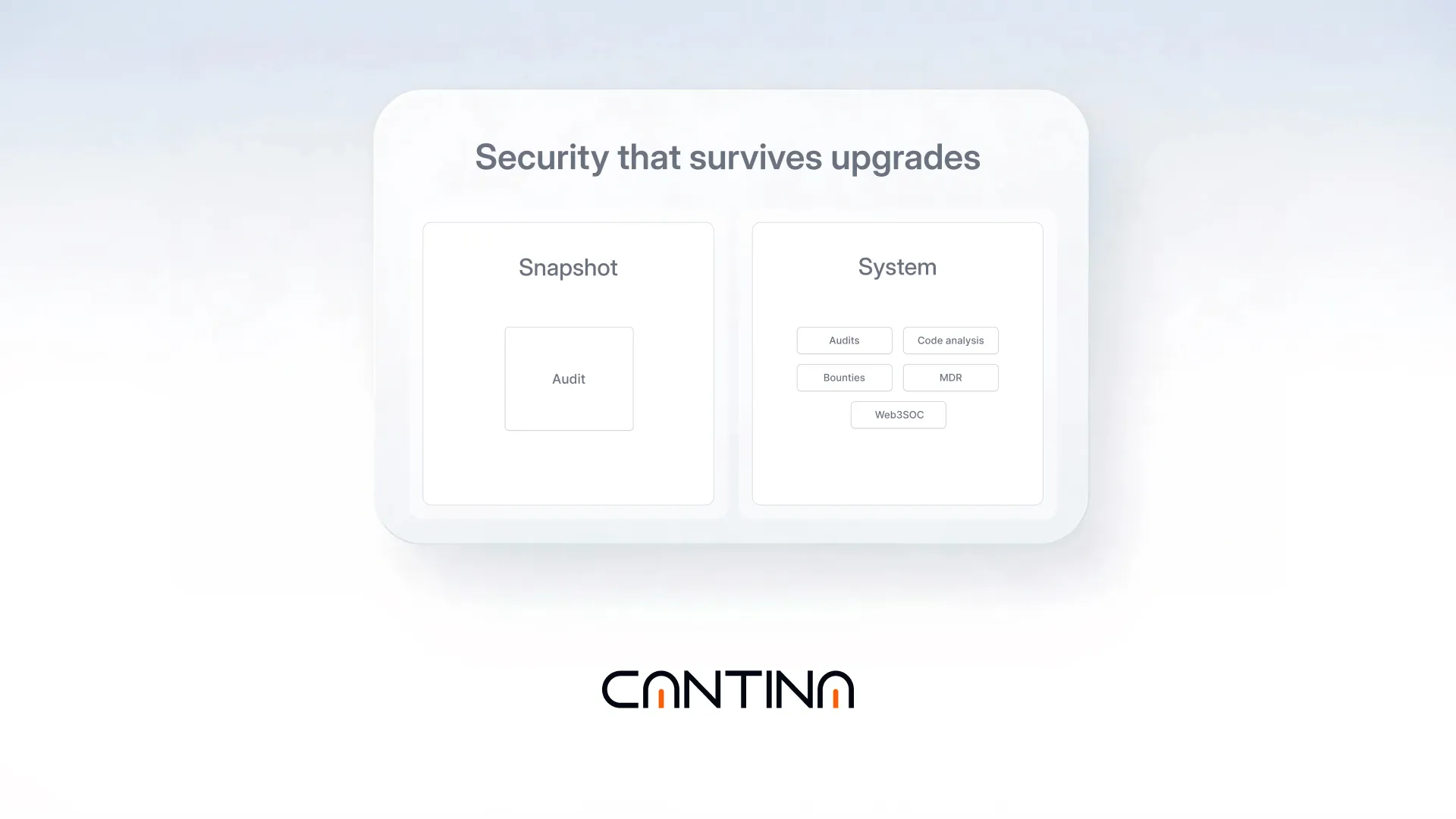

When a protocol becomes part of other people’s architecture, the security problem changes. Liquidity is deeper, routes converge on your contracts, and a single decision about upgrades, roles, or monitoring can move markets and reputations. At that stage, risk looks less like isolated bugs and more like chain reactions across contracts, operators, and time to response.
This piece is for founders, CTOs, and protocol leads who already know how to ship and now need a system that keeps up with the scale of what they are running.
If you prefer to skip straight to a structured assessment, you can contact us and we will walk your protocol through this playbook and turn it into a concrete plan.
What actually fails at scale
Large incidents usually follow a simple pattern. A normal issue lines up with a change and an operational gap.
Typical sequences look like this:
- An upgrade shifts an invariant and the new assumption was never written down or challenged.
- A role or key has broader power than anyone remembers and its use is not monitored with clear ownership.
- An oracle or pricing path works in most conditions, then hits an edge case during volatility while alerts fire to the wrong person or with no clear runbook.
- A known class of bug is documented, but the fix is queued behind product work and ships later than it should.
In post mortems, the exploit path is only half the story. The other half is how long it took to accept that something was wrong, who had the authority to act, and whether execution was coordinated.
Protocols that survive their bad days tend to have built for that half from the beginning.
The security system that keeps its shape
Once you are infrastructure, you do not want a list of tools. You want a small number of capabilities that connect.
You can think about it as four layers.
1. Design and review for high impact changes
Audits are still the first line, but the scope shifts. The focus moves from counting findings to understanding where blast radius comes from.
High value review work concentrates on:
- Upgrade mechanics and rollback paths
- Roles, admin controls, and emergency actions
- Oracle, pricing, and liquidation assumptions
- Invariants around minting, burning, and accounting
- Cross contract trust boundaries and external calls
The important property is continuity. The people who review your most sensitive changes understand how today’s decisions connect to previous ones instead of treating every engagement like a fresh codebase.
Cantina runs these reviews for high TVL protocols that need someone to own that continuity. If you want that model instead of one off audits, our team can scope it with you.
2. Continuous analysis between reviews
Real protocols ship often. Risk appears in diffs, not only in greenfield code.
Continuous analysis gives you two advantages:
- It highlights diffs that expand privileges, touch invariants, or alter external call patterns.
- It lets automated systems, including AI based analyzers, surface suspicious patterns so human reviewers spend time on the small set of changes that matter.
Used correctly, this layer does not spam developers. It acts as a routing engine that tells you where expert attention is worth spending.
3. Adversarial pressure from people who do not work for you
Bug bounties and structured competitions do two useful things:
- They bring fresh eyes and different mental models to your live surface area.
- They force you to harden your triage and payout process, which in turn clarifies how you think about severity and impact.
A bounty program has real value when scope maps to economic reality, triage is predictable, and remediation has an owner. At scale, this is also where you capture attack ideas that your own audits and analysis might not prioritize.
Cantina coordinates large scale competitions and ongoing bug bounty programs. If you want to translate this layer into a concrete bounty design for your protocol, you can reach out and we will design it around your actual attack surface.
4. Detection and response with real decision power
Detection without execution is noise. Execution without detection is guesswork.
An operational layer, whether you call it MDR, a Web3 SOC, or something else, has a clear job:
- Turn protocol specific failure modes into concrete alerts.
- Route those alerts to people with the authority to act.
- Back those people with tested runbooks and a path from first signal to containment.
On a bad day, practical details decide the outcome. Who has access to which keys. Which contracts can be paused and how that interacts with integrators. How you communicate with users, partners, and exchanges in the first hour. Whether you have practiced any of this when nothing was at stake.
Cantina’s MDR is built for this exact layer. If you want to see how your current monitoring and incident plan compares, our team can run a short readiness session and show you the gap.
Cantina’s stack exists to wire these pieces together: audits and design audits, competitions and bounties, AI based code analysis, managed detection and response, and web3soc. The goal is simple. Every new insight moves across the stack instead of dying in a different system.
A short readiness check for protocols that are already big enough to be targets
You can use the questions below as a quick internal review. They are not exhaustive, but if several of them feel uncomfortable, you have useful signal.
Architecture and upgrades
- For each upgrade, can someone outside the core dev circle read a one page explanation of what changes, what could break, and how you would roll it back.
- Do you classify changes by risk level and route higher risk diffs through deeper review and testing.
Roles, keys, and governance
- Can you list who can move what, pause what, and upgrade what, and do you have checks that confirm this is still true.
- Do you have a realistic key rotation and signer refresh plan that has actually been executed at least once.
- Are emergency actions documented with thresholds for use, and do they require more than one person to approve.
Monitoring and signal
- Do you have alerts tied directly to your own failure modes, such as unusual role use, unexpected mints or burns, abnormal TVL movement relative to markets, oracle deviation, or parameter changes outside expected windows.
- For each alert class, is there a named owner and a clear fallback if they are unavailable.
Response and communication
- Have you run at least one live or tabletop exercise where you simulate a real exploit path, walk through decisions, and update your runbooks based on what you learned.
- Are draft communications for users, partners, and liquidity venues already written and stored in a place people can find during stress.
If the honest answer to many of these questions is “we could figure it out on the day,” then you are betting on luck and individual heroics rather than a system.
If you want this checklist applied directly to your protocol with concrete recommendations, reach out to Cantina and we will run a focused security readiness review for you.
When this becomes urgent
The triggers are straightforward:
- Large upgrade or new product line
- Expansion to new chains, assets, or markets
- Meaningful growth in integrations and routing volume
- Exchange listing, institutional diligence, or regulatory attention
If at least one of these is coming up, the next practical step is a short security readiness review that maps your current posture to a plan across design review, adversarial testing, continuous analysis, and detection and response.
That is the context in which Cantina works best. If you are entering that phase and want one partner to coordinate the full stack, contact our team and we will scope the work around your roadmap and risk profile.